Chinese Soul Food by Hsiao-Ching Chou
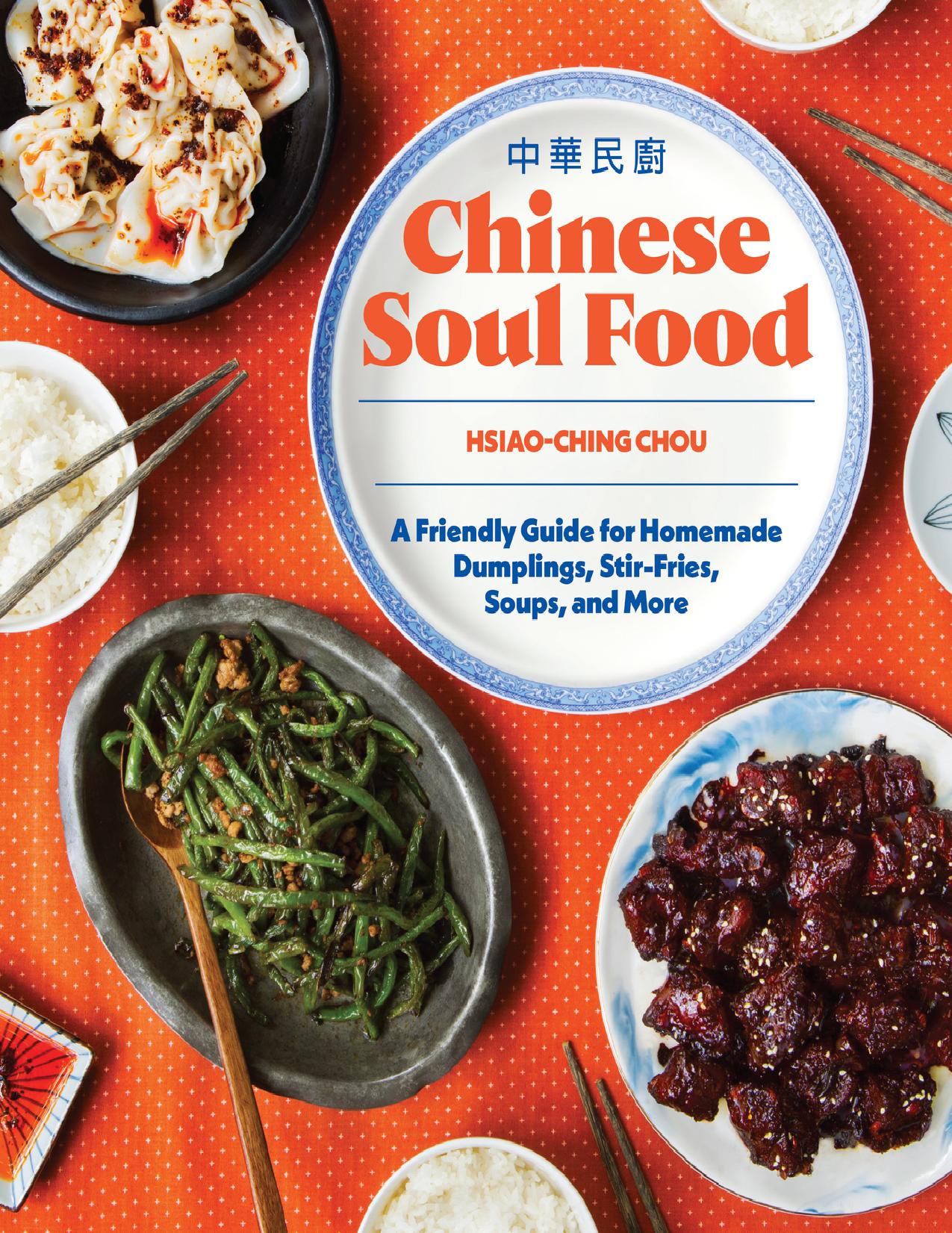
Author:Hsiao-Ching Chou
Language: eng
Format: epub, pdf
Publisher: Sasquatch Books
Published: 2018-01-30T05:00:00+00:00
Baby Bok Choy with Chicken
Simple Stir-Fried Greens
Wok-Seared Corn and Green Onions
Tomato Egg
Stir-Fried Shoestring Potatoes
Cauliflower with Country Ham and Jalapeños
Garlic Eggplant
Dry-Fried Green Beans
Ma Po Tofu
Kung Pao Chicken
Three-Cup Chicken
Chicken with Snow Peas
Beef with Asparagus and Shiitake Mushrooms
Beef with Pickled Chinese Mustard Greens
Orange Beef
Five-Spice Tofu Gan with Slivered Pork and Celery
Twice-Cooked Pork
Spicy Clams with Chinese Sausage
Even when there’s “nothing” in the refrigerator and I’m running behind schedule, I always can find some combination of vegetables, aromatics, and a small amount of protein to stir-fry quickly and serve with steamed rice. This means I never worry about putting dinner on the table for my family. Armed with the basic principles behind everyday stir-fries and some practice with the recipes here, you soon will be just as capable of improvising ingredient combinations. I encourage you to experiment, because the beauty of a stir-fry is that it can bend to whatever ingredients you have on hand and to your particular stove and pan situation. Certainly, using a wok is ideal. But if you don’t have a wok yet, don’t let that stop you from making a skillet stir-fry. To be clear, I’m not saying that a skillet is a good substitute for a wok when it comes to stir-frying; I simply want to empower people to get into the kitchen.
When I teach classes on stir-frying, my favorite aha moment to witness is when a student finishes making a straightforward dish, such as Baby Bok Choy with Chicken, and then takes the first bite. Universally, the response is: “I had no idea it was that easy and so delicious.” My reply is always a reminder: “And you made it.” Seeing the light in people’s eyes is my reward.
The subject of stir-frying inevitably triggers a comment—or complaint—about all the cutting and prep work involved in Chinese cooking. Here is where Asian and many Western cuisines diverge. Stir-frying is a high-heat, quick-cooking method that necessitates ingredients to be cut uniformly into bite-size pieces so they then can be eaten with chopsticks. I will slice up flank steak to cook with asparagus segments and soy sauce for a stir-fry. On another night, when I’m not cooking Chinese dishes, I may take that same flank steak with asparagus, season them with olive oil, salt, and pepper, and then grill them whole. Then I have to set the table with knives and forks. Cutting is still necessary; it just takes place after cooking.
Most of the recipes in this chapter offer room for improvisation. Love garlic? Add some. Don’t have bok choy but your garden is overgrown with kale? Use the kale. Need to make a gluten-free version? Use salt instead of soy sauce—or a gluten-free soy sauce. Unlike baking, stir-frying is laid-back. Let the recipes inspire you as you build your own repertoire.
Download
This site does not store any files on its server. We only index and link to content provided by other sites. Please contact the content providers to delete copyright contents if any and email us, we'll remove relevant links or contents immediately.
Biscuits: A Savor the South Cookbook by Belinda Ellis(4328)
The French Women Don't Get Fat Cookbook by Mireille Guiliano(3651)
A Jewish Baker's Pastry Secrets: Recipes from a New York Baking Legend for Strudel, Stollen, Danishes, Puff Pastry, and More by George Greenstein(3585)
Ottolenghi Simple by Yotam Ottolenghi(3581)
Better Homes and Gardens New Cookbook by Better Homes & Gardens(3580)
Al Roker's Hassle-Free Holiday Cookbook by Al Roker(3522)
Trullo by Tim Siadatan(3422)
Bake with Anna Olson by Anna Olson(3397)
Hot Thai Kitchen by Pailin Chongchitnant(3377)
Panini by Carlo Middione(3330)
Nigella Bites (Nigella Collection) by Nigella Lawson(3226)
Momofuku by David Chang(3183)
Salt, Fat, Acid, Heat: Mastering the Elements of Good Cooking by Nosrat Samin(3138)
Modern French Pastry: Innovative Techniques, Tools and Design by Cheryl Wakerhauser(3135)
Classic by Mary Berry(3009)
Best of Jane Grigson by Jane Grigson(2994)
Tapas Revolution by Omar Allibhoy(2976)
Solo Food by Janneke Vreugdenhil(2966)
Ottolenghi - The Cookbook by Yotam Ottolenghi(2928)
